
Integrated manufacturing support
Vesimentor is one of a small number of plastic contract manufacturers in the Baltic and Nordic region certified to AQAP 2110 — the NATO Quality Requirements for Design, Development and Production. Combined with ISO 9001 and ISO 14001, vertically integrated capability across moulding, machining, finishing and assembly, and EU-jurisdiction intellectual-property protection, this makes us a qualifying supplier for defence, security and critical-infrastructure programmes that demand traceable quality, controlled change management and confidential customer relationships.
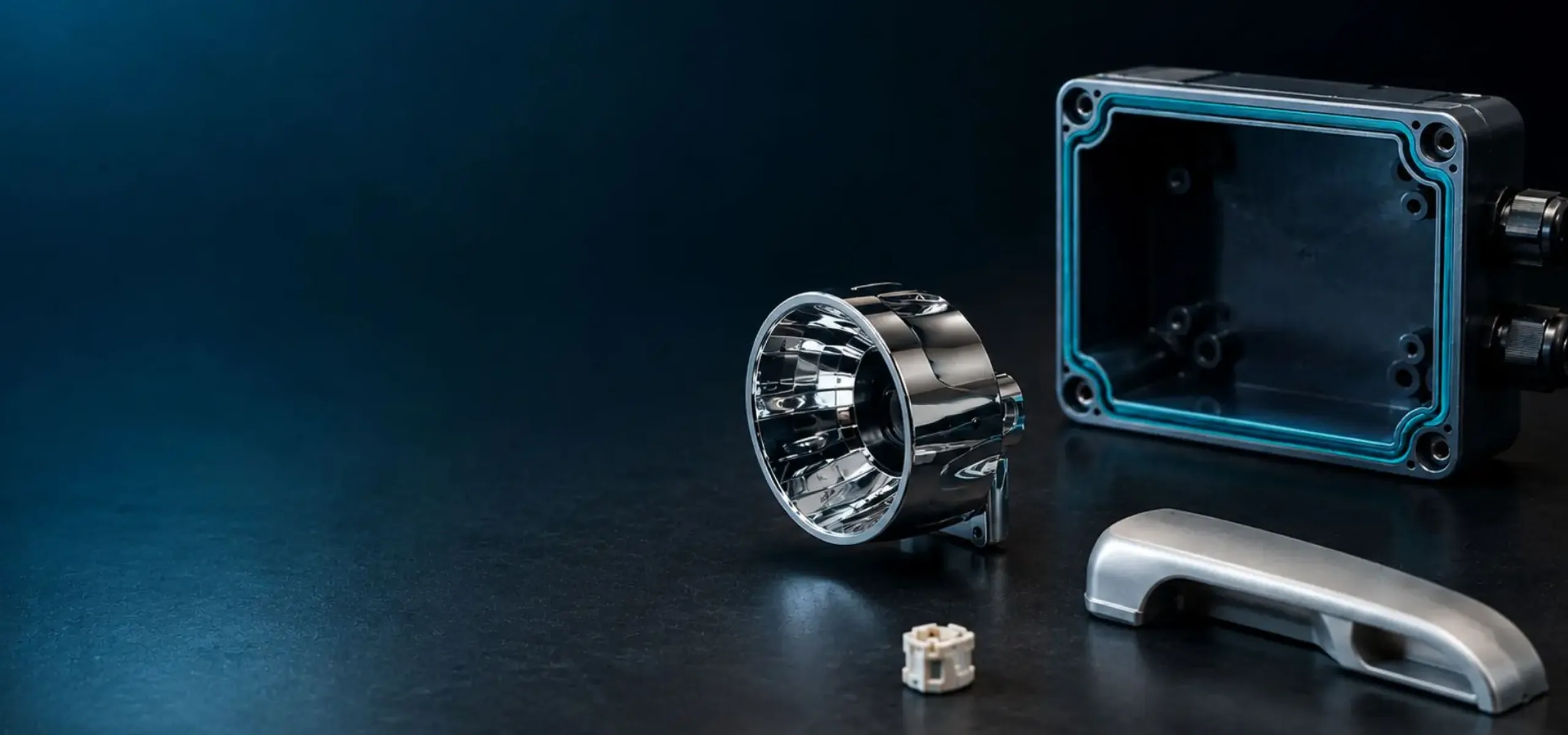
What AQAP 2110 means in practice
AQAP 2110 (Allied Quality Assurance Publication 2110) sets the quality requirements that NATO and NATO-aligned customers apply to suppliers involved in the design, development and production of defence-relevant goods. It builds on ISO 9001 and adds defence-specific obligations: configuration management, controlled change processes, government quality assurance representative access, traceability of materials and processes, deviation control, and obligations on subcontractor management. For a plastic component supplier this translates into auditable batch records, controlled material qualification, formal change-management on every process parameter and full subcontractor traceability — exactly what defence and critical-infrastructure procurement teams require to qualify a supplier into a programme.
Vesimentor operates under ISO 9001, ISO 14001 and AQAP 2110. Vesimentor maintains it as a deliberate strategic differentiator — it qualifies us into procurement processes from which uncertified competitors are simply excluded.
Vertically integrated capability for defence applications
Defence and critical-infrastructure plastic components rarely involve a single process. A rugged enclosure may need rotational moulding for the housing body, CNC machining for inserts and inspection windows, vacuum metallizing for RF / EMI shielding or decorative finishes on service equipment, and FIPFG sealing or potting for ingress and shock protection of electronic content. Injection-moulded sub-components, ultrasonic-welded housings and tampoprinted markings complete the assembly. All produced under one quality system, against one auditable batch record, in one EU-jurisdiction facility.
For defence procurement, this matters in three concrete ways. First, configuration management: every process parameter, every material batch, every subcontractor input is documented under a single controlled system rather than scattered across four supplier contracts. Second, change control: any deviation from the agreed process is governed by one change-management protocol — not negotiated separately with each subcontractor. Third, security and confidentiality: a single supplier agreement and a single facility footprint reduce the IP exposure surface compared to a multi-supplier chain that crosses borders or jurisdictions.
Capabilities relevant to defence and critical-infrastructure programmes
- Rugged enclosures and ruggedised housings — rotational moulding for large impact-resistant single-piece bodies in PE; injection moulding in glass-filled engineering thermoplastics for structural housings; assembled with ultrasonic welding and FIPFG environmental sealing for IP65+ duty.
- RF and EMI shielding via metallizing — vacuum-deposited aluminium layers on plastic substrate, with controlled thickness and continuity, used for electromagnetic interference attenuation in plastic enclosures where a metal housing is impractical for weight, isolation or design reasons.
- Mission-critical sealed assemblies — moulded substrate, in-line FIPFG foam-gasket sealing applied to the closed contour of the housing, ultrasonic-welded or screwed closure, and final inspection — all in one workflow with full batch traceability.
- Field equipment and service casings — moulded, finished, marked (tampoprint, embedded labels, RFID inserts where required) and assembled into customer-specified configurations.
- CFRP and GFRP test parts and prototypes — CNC-machined fibre-reinforced composite components for test, qualification and pre-production work under AQAP 2110 controls.
- Subcontractor and material traceability — every material batch identified, every process parameter logged, every change controlled and approved through formal change management.
EU jurisdiction, IP protection and supply chain resilience
Estonia is an EU member state, a NATO member and operates under EU-aligned intellectual-property and export-control regimes. For European defence primes and critical-infrastructure operators, an EU-jurisdiction supplier reduces several supply-chain risks simultaneously: no third-country export-control friction on EU-internal defence work, EU-grade IP protection backed by EU courts, no Far-East dependency for a strategic input, and a transit-time profile (typically two days by truck across most of mainland Europe) that supports resilient just-in-time and surge-production scenarios.
Pärnu, Estonia is one ferry-and-truck hop from Helsinki, Stockholm, Riga, Warsaw, Hamburg and beyond. As a single EU-jurisdiction supplier with full vertical integration, Vesimentor reduces the procurement-team workload of multi-supplier qualification, the legal workload of multi-NDA management, and the audit workload of multi-facility quality oversight.
How to engage Vesimentor for a defence or critical-infrastructure programme
Programmes are engaged under bilateral non-disclosure agreement at first contact. We do not disclose customer names, programme identities, end-user information or design content in marketing materials, and we do not require disclosure of programme detail before NDA. Initial conversations focus on capability fit — the production technologies and quality system needed for the programme — and progress to feasibility, qualification and production planning under the customer’s preferred contractual framework.
For procurement teams evaluating EU-jurisdiction AQAP 2110 plastic suppliers, our response timeframe to a sanitised RFI is typically 5–10 working days, depending on the technical depth required.
info@vesimentor.ee
Vesimentor OÜ · Kase tn 10, 80047 Pärnu, Estonia · +372 5687 4999
NATO AQAP 2110 Quality Control and Plastic Component Manufacturing
As a certified AQAP 2110 plastic manufacturer, Vesimentor operates under strict military and aerospace-grade quality standards. Compliance with the NATO AQAP 2110 standard (Allied Quality Assurance Publications) requires a comprehensive approach to quality planning, process reliability, risk management, and configuration control. From initial design-for-manufacturing (DFM) reviews to final inspection, every step of our injection moulding, rotational moulding, and vacuum forming process is fully documented and traceable. This level of quality assurance is critical for defence contractors, military primes, and aerospace suppliers looking for a qualified partner in the Baltics and Nordics. Our ISO 9001, ISO 14001, and AQAP 2110 certification guarantee that we can meet the most demanding requirements for combat equipment housings, field terminals, ruggedized transport casings, and shielded electronics enclosures.
Frequently Asked Questions
- What is AQAP 2110 and how does it differ from ISO 9001?
- AQAP 2110 is the NATO Quality Assurance Publication that defines the quality requirements applied to suppliers involved in the design, development and production of defence-relevant goods. It builds on ISO 9001 and adds defence-specific obligations including configuration management, controlled change processes, government quality assurance representative access, formal traceability of materials and processes, deviation control and explicit obligations on subcontractor management. ISO 9001 establishes the underlying quality management system; AQAP 2110 layers defence-procurement-grade governance on top.
- Why is AQAP 2110 certification rare among plastic manufacturers?
- AQAP 2110 imposes ongoing obligations — auditable batch traceability, formal change-management on process parameters, controlled subcontractor qualification — that most general-purpose plastic contract manufacturers find disproportionate to their non-defence revenue. For a manufacturer choosing to certify, the value lies in qualifying for procurement processes from which uncertified competitors are excluded. Vesimentor maintains AQAP 2110 as a deliberate strategic position rather than a procedural compliance exercise, and it is one of the credentials we maintain for defence and critical-infrastructure work.
- What types of defence and critical-infrastructure components does Vesimentor produce?
- We can describe capability against component categories without disclosing specific programmes or customers: rugged enclosures and ruggedised housings, mission-critical sealed assemblies with FIPFG environmental sealing, field equipment and service casings, RF / EMI shielded plastic enclosures via vacuum-deposited aluminium, and CNC-machined CFRP and GFRP test parts and prototypes. All produced and assembled in one EU-jurisdiction facility under AQAP 2110 governance.
- How does Vesimentor handle confidentiality and NDA in defence engagements?
- Programmes are engaged under bilateral non-disclosure agreement at first contact. We do not disclose customer names, programme identities, end-user information or design content in marketing materials, and we do not require disclosure of programme detail before NDA. Initial conversations focus on capability fit — the production technologies and quality system the programme requires — and only progress to programme-specific detail once an appropriate confidentiality framework is in place.
- What is the advantage of an EU-jurisdiction plastic supplier for defence procurement?
- For European defence primes and critical-infrastructure operators, an EU-jurisdiction supplier reduces several supply-chain risks: no third-country export-control friction on EU-internal defence work, EU-grade intellectual-property protection backed by EU courts, no Far-East dependency for a strategic input, and a transit-time profile that supports resilient just-in-time and surge-production scenarios. Vesimentor combines these EU-jurisdiction advantages with full vertical integration of plastic processes — a combination relevant to defence procurement teams looking to consolidate qualified supplier counts.