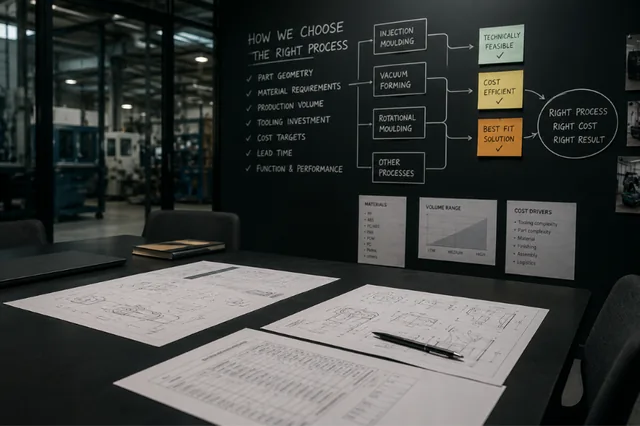
Procurement teams routinely run plastic-component supply chains across four or five separate suppliers — an injection moulder, a vacuum metallizer, a CNC shop, a sealing or potting subcontractor, an assembly house. Each handover adds cost, lead time, quality variance, an additional contract, an additional NDA and an additional accountability gap. Vesimentor performs all of these processes in one facility under one quality system. This page explains why that matters in practice and how it shows up in cost, time and risk.
The hidden cost of a four-supplier plastic chain
A typical decorated and sealed plastic assembly — a luminaire, a sensor housing, a sealed enclosure for outdoor electronics — passes through several distinct production processes. With a traditional multi-supplier model the part travels: from the injection moulder to the metallizing house (transport, packaging, intermediate storage, customs paperwork if borders are crossed); from the metallizing house to the CNC shop for trimming or feature machining (more transport, more handling); from the CNC shop to the sealing or potting house (more transport); from the sealing house to the assembly house; from assembly to the customer.
Each handover incurs a margin markup at the receiving supplier, transport cost, handling damage risk, intermediate quality inspection, and a coordination overhead at the customer's procurement team. Industry studies on vertical integration consistently show that the headline savings on the moulded part itself — typically 5–12% — understate the true total saving once these handover costs, coordination costs and lead-time costs are properly accounted for. Lead-time reductions of several weeks are common for complex assemblies that previously required multi-supplier coordination.
What Vesimentor does in-house
Under one roof in Pärnu, Estonia, Vesimentor operates the full range of plastic production technologies and the downstream finishing and assembly processes that turn a moulded part into a customer-ready assembly:
- Injection moulding — clamping force 50 to 500 tons, shot volume up to 1800 cm³, technical thermoplastics PA, PE, PP, ABS, POM, PC, PC/ABS, PMMA with glass and mineral filled grades.
- Rotational moulding — large hollow PE parts, tanks, enclosures and ruggedised housings.
- Vacuum forming (thermoforming) — sheet up to 1.4 × 1.4 m in ABS, PMMA, PC, PETG.
- Vacuum casting (PU) — prototypes and small series from silicone tools.
- Vacuum metallizing (PVD) — chrome / gold / copper / bronze finishes with custom tinted top-coat lacquer; functional metallizing for sensor and RF / EMI applications.
- CNC machining — engineering plastics and CFRP / GFRP composites; prototypes, small series, post-processing of moulded parts.
- FIPFG foam-gasket sealing and potting — in-line environmental sealing of housings, electronic component encapsulation.
- Ultrasonic welding — joining thermoplastic housings without adhesives or fasteners.
- High-frequency welding, tampoprint, and final assembly — completing the assembly to customer-specified configuration.
Underpinning all of this: ISO 9001 (quality management), ISO 14001 (environmental management) and AQAP 2110 (NATO Quality Requirements). One quality system controls all process steps — substrate, finish, machining, sealing, assembly. One audit, one set of batch records, one set of traceability documents.
The four concrete benefits for an OEM customer
- Lead time reduction. Eliminating four inter-supplier transport legs and four separate quality-acceptance loops typically removes one to several weeks from a complex assembly's lead time. For programmes with frequent design iterations or short replenishment windows the lead-time saving is often the dominant procurement advantage.
- Cost saving on hidden costs. The unit-price quotation of a multi-supplier chain rarely captures the inter-supplier transport cost, intermediate handling, intermediate inspection, multi-supplier coordination and the procurement-team workload of running the chain. An integrated supplier compresses these into a single line.
- Quality consistency and accountability. When the same quality system controls substrate moulding, surface finish, machining, sealing and assembly, performance is more consistent and quality issues do not get lost in the gap between two suppliers' QA systems. There is one accountable partner for the entire moulded-and-finished assembly.
- Confidentiality and IP exposure surface. One supplier means one NDA, one set of design files in one supplier's hands, one facility that needs to be audited for security. Multi-supplier chains scatter the design content across four or more sets of supplier hands — each a potential information-leakage point.
How a typical Vesimentor project looks
A typical assembled product we deliver to a customer might consist of around eight different plastic parts. Of those, one part needs vacuum metallizing for a chrome-finish reflector or decorative trim, one needs a FIPFG foam-gasket seal for environmental protection, and the remaining six are straightforward injection-moulded components in technical thermoplastics. Our role is to mould all eight parts on our own machine park, apply the metallizing and the gasket where required, machine any post-features, perform final assembly into one unified product, and pack and ship the finished assembly to the customer’s distribution centre or production line.
This is the integration that adds genuine value. The customer specifies one assembled product, sends one purchase order, receives one delivery, signs one quality release and audits one supplier. They do not run an injection-moulder contract, a separate metallizing contract, a separate sealing contract and a separate assembly contract for the same product. The unit-economics on the moulded parts themselves remain competitive — our machine park, material purchasing and operational efficiency keep us price-competitive against single-process specialists on the moulding line items — and the integrated finishing, assembly and packaging are delivered on the same competitive cost base, not as a premium.
For customers with simpler requirements — a single moulded part, no downstream processes, no assembly — Vesimentor is equally available. We are a contract manufacturer for plastic components in all forms: from a single straightforward moulded part at a competitive unit price to a multi-part assembled and packed finished product, in the same facility, with the same quality system, and the same response time. The integrated capability is what we add when a customer needs it — not a barrier to working with us when they don’t.
Engaging Vesimentor for an integrated project
Send drawings, 3D models, specifications or a description of the assembly you currently produce across multiple suppliers. Our engineering team responds with a feasibility assessment, process recommendation, an indicative lead-time profile and an indicative pricing comparison against your current multi-supplier baseline. Initial discussions are conducted under bilateral non-disclosure agreement when appropriate.
This email address is being protected from spambots. You need JavaScript enabled to view it.
Vesimentor OÜ · Kase tn 10, 80047 Pärnu, Estonia · +372 5687 4999
Frequently Asked Questions
- What does "vertically integrated plastic manufacturer" actually mean?
- A vertically integrated plastic manufacturer performs the multiple production processes needed for a finished plastic assembly — moulding, machining, finishing, sealing, assembly, packaging — in one facility under one quality system, rather than relying on a network of single-process subcontractors. For Vesimentor this means injection moulding, rotational moulding, vacuum forming, vacuum casting, vacuum metallizing, CNC machining, FIPFG sealing, ultrasonic and high-frequency welding, tampoprint, final assembly and packaging are all in-house.
- Does Vesimentor only take on complex multi-process assemblies, or also single moulded parts?
- Both. Vesimentor is a full-service plastic contract manufacturer — from a single injection-moulded commodity part at a competitive unit price to a fully assembled and packed multi-part finished product. Our machine park, material purchasing and operational efficiency keep us price-competitive against single-process specialists on the moulding line items, while our in-house finishing, assembly and packaging make us the natural choice when a customer wants a complete assembled product delivered as one item against one quality record.
- What does a typical Vesimentor project look like?
- A typical assembled product we deliver consists of around eight different plastic parts. Of those, one might need vacuum metallizing for a chrome-finish reflector or decorative trim, one might need a FIPFG foam-gasket seal for environmental protection, and the remaining six are straightforward injection-moulded components. We mould all eight on our own machine park, apply the metallizing and the gasket where required, perform final assembly, and pack and ship the finished product to the customer. One purchase order, one delivery, one quality release, one supplier audit.
- Is Vesimentor price-competitive against single-process moulding specialists?
- Yes. Our machine park, material purchasing and operational efficiency are tuned to keep our injection-moulding unit prices competitive against specialist single-process suppliers, even before any integrated finishing or assembly content is added. The integrated services — metallizing, sealing, machining, assembly and packaging — are delivered on the same competitive cost base, not as a premium. Customers can engage us for a single commodity moulded part or for a fully assembled and packed multi-part product with equally competitive economics.
- How does vertical integration reduce lead time?
- A multi-supplier chain incurs lead-time penalties at each handover — transport between suppliers, packaging and unpacking, intermediate quality acceptance, scheduling between supplier production windows. Eliminating those penalties for a multi-part assembled product typically removes one to several weeks. For programmes with frequent design iterations or short replenishment windows the lead-time saving is often the dominant procurement benefit, alongside the unit-price competitiveness.
- What is the confidentiality advantage of working with one integrated supplier instead of four?
- A multi-supplier chain scatters the design content of an assembly across four or more sets of supplier hands — each a potential information-leakage point and each requiring its own non-disclosure agreement. An integrated supplier consolidates this into one NDA, one supplier-side design file location and one facility for the customer to audit. For programmes with sensitive design content — defence, premium consumer brands, IP-rich products — this consolidation is a meaningful procurement risk reduction.
We are social!
Like our page on Facebook and receive the updates on our products, activities and other related news straight on your news feed.
Don't forget to share our page so that your friends may also stay up-to-date.